
★ Moneyball Original · Opinion
SV Elversberg: the smallest club in Bundesliga history is taking over the league
By Moneyball Editorial · published · updated
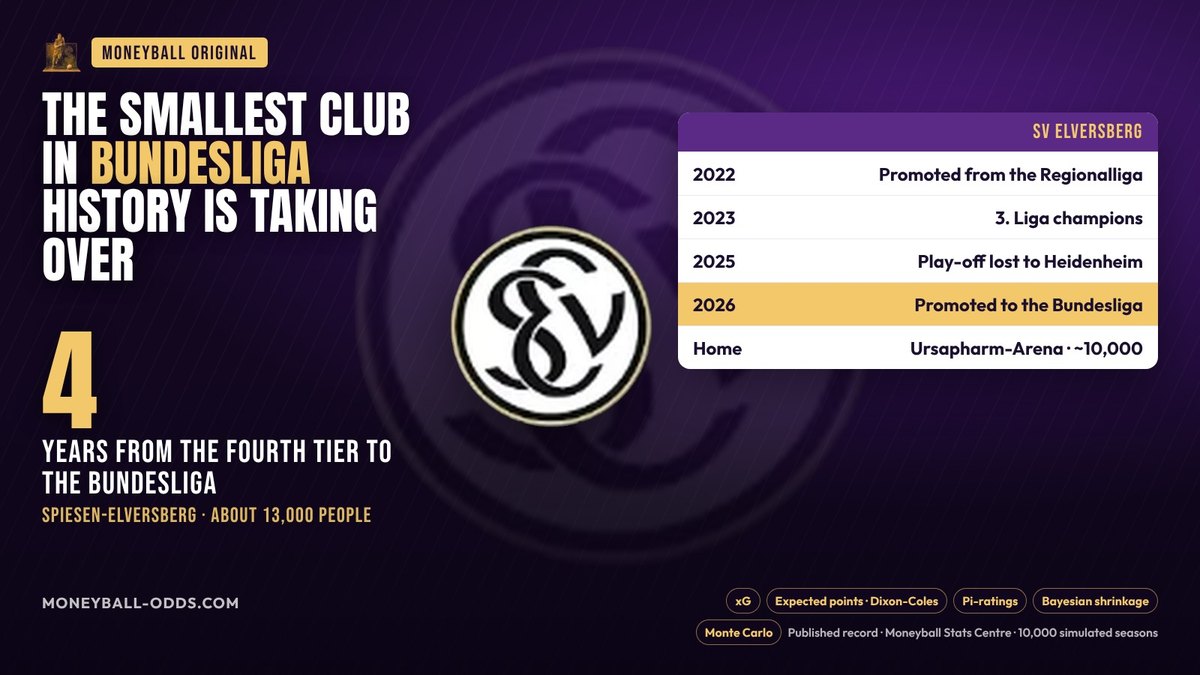
Four years ago SV Elversberg were playing in the Regionalliga Südwest, the fourth tier of German football, in front of a few thousand people. Today they are in the Bundesliga, 7th in the table on 13 points from 9 matches, and the clubs they have beaten include Bayer 04 Leverkusen, Borussia Mönchengladbach, FC Augsburg. They come from Spiesen-Elversberg, a municipality in Saarland of about 13,000 people, which is why they are called the smallest club in Bundesliga history.
Football loves a story like this, and football usually ruins it by February. Moneyball's job is to ask the cold question underneath the warm one: is Elversberg's start real, or is it a run of results that the chances do not support? Twelve methods, the Stats Centre for the club and for every player, and the season played out 10,000 times.
A village, a pharmacy and a ladder of four leagues
The short history is worth telling properly, because it explains the football. SV 07 Elversberg were a fourth-tier club for most of their life. The money behind them is local: Ursapharm, an eye-care pharmaceutical company from the same corner of Saarland, whose name is on the stadium, the Ursapharm-Arena an der Kaiserlinde. The football was built by Horst Steffen, who arrived in 2018 and climbed the ladder one rung at a time: promotion from the Regionalliga in 2022, the 3. Liga title in 2023, a first season in the 2. Bundesliga, and then third place in 2025 and a play-off against Heidenheim that they lost by one goal. Steffen left for Werder Bremen that summer. Most clubs would have fallen apart. Elversberg went up the next season.
There is no academy pipeline built over decades and no billionaire. There is a recruitment idea: young players other clubs undervalue, loan players who need minutes, and a style that makes the most of both. That is the kind of club Moneyball was invented to explain.
The season, match by match
| Date | Match | Score | xG (Elversberg – opponent) | Result | Expected points |
|---|---|---|---|---|---|
| 29 August 2026 | v Bayer 04 Leverkusen | 3-2 | 1.25 – 1.91 | W | 0.96 |
| 5 September 2026 | at Borussia Mönchengladbach | 4-3 | 2.70 – 2.74 | W | 1.39 |
| 13 September 2026 | v FC Bayern München | 1-2 | 1.03 – 2.46 | L | 0.59 |
| 20 September 2026 | at Schalke 04 | 0-0 | 1.24 – 1.25 | D | 1.35 |
| 10 October 2026 | at FC Union Berlin | 0-1 | 0.25 – 1.59 | L | 0.39 |
| 17 October 2026 | v FC Augsburg | 4-3 | 4.55 – 4.23 | W | 1.56 |
| 24 October 2026 | at RB Leipzig | 0-4 | 0.64 – 2.49 | L | 0.37 |
| 30 October 2026 | v FSV Mainz 05 | 4-1 | 1.23 – 1.71 | W | 1.06 |
| 7 November 2026 | at Borussia Dortmund | 1-2 | 1.43 – 1.64 | L | 1.24 |
The last column is what each performance usually earns: the match's xG for both sides run through the Dixon-Coles score matrix. In 3 matches (v Bayer 04 Leverkusen, at Borussia Mönchengladbach, v FSV Mainz 05) Elversberg took at least a point and a half more than the chances usually give. That is where a promoted side's dream start is built.
The table, four ways
| Measure | Elversberg | Rank of 18 |
|---|---|---|
| League position (points) | 13 pts from 9 | 7th |
| Expected points (from xG) | 8.9 from 9 | 16th |
| Pi-rating (goal margin vs average) | −0.01 | 8th |
| Strength after shrinkage (xG margin per match) | −0.34 | 13th |
| Projected final points | 42 | 12th |
This is the table that matters most in this column. On points Elversberg are 7th. On expected points, the points their chances usually earn, they would have 8.9, which is 16th. That gap of +4.1 points is the honest heart of the story: the results are running ahead of the football. Their xG margin is −0.63 a match, 13th once Bayesian shrinkage has taken the noise out of a short season. The Pi-rating, built from results and goal margins alone, ranks them 8th, and the projection lands on about 42 points (12th).
The goals are real. So are the goals against.
Elversberg have scored 17 from 14.3 xG (+2.7) and conceded 18 from 20.0 xG against (+2.0 kept out). The finishing is well above the chances. Some of that is quality, young forwards hitting the ball cleanly, and some of it is the kind of streak that cools; the regression method expects part of it to come back to earth. At the other end the goalkeeper has kept out more than the shots faced deserve.
The number that worries the model most is the xG against: 2.22 a match. A promoted side that allows that many chances needs its finishing to stay hot; one that tightens up can stay in the league for years. Promoted sides that stay up comfortably usually do it by cutting that number as the season goes on.
The fortress at the Kaiserlinde
At home: 9 points from 4 matches (2.25 a match). Away: 4 from 5 (0.80 a match). A small, tight ground with the crowd on top of the pitch is worth real points to a club like this: big clubs arrive expecting to dominate, and find a team that runs at them. The home form is the foundation the whole season stands on.
How Elversberg play
| Per match, Bundesliga | SV Elversberg | Rank of 18 |
|---|---|---|
| Possession | 46.0% | 13th |
| Pass accuracy | 79.7% | 13th |
| Passes | 392 | 14th |
| Long balls | 20.2 | 10th |
| Pressure Index | 36.9 | 14th |
| Dribbles | 8.9 | 3rd |
| Interceptions | 11.2 | 6th |
| Tackles | 14.7 | 15th |
| Shots | 11.2 | 16th |
| Big chances | 1.3 | 16th |
| xG for | 1.59 | 12th |
| xG against | 2.23 | 16th |
They do not need the ball: 46.0% possession (13th). What they do with it is run: 8.9 dribbles a match, 3rd in the Bundesliga. Young attackers taking defenders on is the club's signature. Without it they read the game: 11.2 interceptions a match (6th), a mid-block that waits for the pass rather than chasing the man. The weakness is volume: 1.3 big chances a match (16th) from 11.2 shots (16th). Elversberg score more than teams who make chances like theirs usually do, which is why the finishing line above matters so much.
The players: a squad nobody else wanted enough
Elversberg's goals and assists in the Bundesliga this season. Each name opens his Stats Centre page.
| Player | Minutes | Goals | Assists | xG | Rating |
|---|---|---|---|---|---|
| Maurice Krattenmacher | 462 | 4 | 1 | 2.37 | 6.90 |
| Lukas Petkov | 801 | 2 | 2 | 2.50 | 7.05 |
| David Mokwa | 657 | 2 | 1 | 1.77 | 6.69 |
| Felix Keidel | 792 | 2 | 1 | 0.46 | 7.13 |
| Cole Campbell | 326 | 2 | 0 | 0.90 | 6.73 |
| Noel Futkeu | 160 | 1 | 1 | 1.42 | 6.65 |
| Francis Onyeka | 314 | 1 | 1 | 1.50 | 6.68 |
| Frederik Schmahl | 134 | 1 | 0 | 0.76 | 6.40 |
Per 90 minutes
| Player (250 minutes or more) | Goals + assists per 90 | xG per 90 |
|---|---|---|
| Maurice Krattenmacher | 0.97 | 0.46 |
| Francis Onyeka | 0.57 | 0.43 |
| Cole Campbell | 0.55 | 0.25 |
| Lukas Petkov | 0.45 | 0.28 |
| David Mokwa | 0.41 | 0.24 |
| Noah Darvich | 0.34 | 0.25 |
Maurice Krattenmacher leads them with 4 goals and 1 assist in 462 minutes, from 2.37 xG. He is finishing well above his chances, the clearest single source of the gap between Elversberg's points and their expected points.
The best-rated players
| Player | Minutes | Rating | Goals | Assists | xG |
|---|---|---|---|---|---|
| Felix Keidel | 792 | 7.13 | 2 | 1 | 0.46 |
| Lukas Petkov | 801 | 7.05 | 2 | 2 | 2.50 |
| Maximilian Rohr | 802 | 7.05 | 1 | 0 | 0.39 |
| Maurice Krattenmacher | 462 | 6.90 | 4 | 1 | 2.37 |
| Lukas Pinckert | 757 | 6.83 | 0 | 1 | 0.47 |
| Nicolas Kristof | 810 | 6.81 | 0 | 0 | 0.00 |
| Lukasz Poreba | 810 | 6.80 | 0 | 0 | 0.10 |
| Cole Campbell | 326 | 6.73 | 2 | 0 | 0.90 |
Scouting Players Research on Maurice Krattenmacher
Maurice Krattenmacher, 21, plays as a wide midfielder for Elversberg in the Bundesliga. Strongest for his role in expected goals and duels won. Weakest in dispossessed.
| Scouting Players Research | Maurice Krattenmacher |
|---|---|
| Role and type | Wide midfielder, direct wide midfielder |
| Moneyball Score (league and European cups, adjusted for strength) | 47 |
| Rank among the wide midfielders of 16 leagues | 47th of 132 |
| Rank among the wide midfielders of his league | 7th of 11 |
| Moneyball Value (estimate) | €6.3M to €20.6M (mid €13.4M) |
| Age curve: score in 1, 2, 3, 4 years | 50 · 52 · 54 · 54 |
| What Scouting weighs for his role | Percentile among wide midfielders |
|---|---|
| Accurate crosses | 8th |
| Key passes | 28th |
| Expected assists (est.) | 35th |
| Successful dribbles | 92nd |
| Tackles | 35th |
| Interceptions | 48th |
| Expected goals | 95th |
| Duels won | 95th |
The players most like him
| Most like him in Scouting | Club | Similarity |
|---|---|---|
| Francis Onyeka | Elversberg | 80% |
| Tidiam Gomis | RB Leipzig | 75% |
| Romain Joy Kouakou Esse | Millwall | 74% |
| Ignacio Peluffo | Tigre | 74% |
| Stanis Idumbo | Monaco | 73% |
This is how a club the size of Elversberg survives: buy or borrow players at a fraction of what they are worth once they play, and let the Bundesliga set the price.
10,000 seasons: taking over, or holding on?
We played the rest of the Bundesliga 10,000 times. Every club plays every match it has left at its own strength (the xG margin per match, shrunk toward the league average while the sample is small), each result drawn from the Dixon-Coles score matrix. No reputation and no budget: only the chances.
| In 10,000 simulated seasons | SV Elversberg |
|---|---|
| Stay up (15th or higher) | 88% |
| Relegation play-off (16th) | 6% |
| Relegated directly (17th or 18th) | 6% |
| A European place (usually the top six) | 8% |
| Champions League places (top four) | 2% |
| Most likely finishing place | 11th |
| Typical final points (median) | 42 |
| Points the 15th-placed club usually ends on | 36 |
| Points the 6th-placed club usually ends on | 53 |
To reach the 36 points that usually keep the 15th-placed club up, Elversberg need 23 more from 25 matches: 0.92 a match, against the 1.44 they have taken so far. The early points are the whole difference: they turn a likely relegation fight into a likely second Bundesliga season.
| # | Club | Pts | xPts | Pts − xPts | Pi | Projected |
|---|---|---|---|---|---|---|
| 1 | FC Bayern München | 21 | 22.2 | −1.2 | +0.25 | 73 |
| 2 | Borussia Dortmund | 21 | 14.9 | +6.1 | +0.15 | 58 |
| 3 | SC Freiburg | 19 | 16.7 | +2.3 | +0.13 | 60 |
| 4 | RB Leipzig | 18 | 17.6 | +0.4 | +0.17 | 61 |
| 5 | Bayer 04 Leverkusen | 16 | 14.7 | +1.3 | +0.05 | 54 |
| 6 | Werder Bremen | 15 | 12.9 | +2.1 | +0.05 | 51 |
| 7 | Elversberg | 13 | 8.9 | +4.1 | −0.01 | 42 |
| 8 | VfB Stuttgart | 12 | 12.0 | +0.0 | −0.00 | 46 |
Is Elversberg taking over the league?
- The results. 7th on 13 points from 9 matches, with wins over Bayer 04 Leverkusen, Borussia Mönchengladbach, FC Augsburg, FSV Mainz 05.
- The chances. 8.9 expected points (16th), an xG margin of −0.63 a match (13th).
- The future. Stay up in 88% of 10,000 seasons, a European place in 8%.
The Moneyball view
The results say yes. The chances say not yet. Elversberg are winning more than their football usually wins, and the story of their season is whether they can turn that cushion into safety before the numbers catch up. Either way, the achievement is already historic. A club from a municipality of 13,000 people, with a ground of around 10,000 places, has gone from the fourth tier to the top half of the Bundesliga table in four years, by finding value where richer clubs did not look. The climb was not luck. It is the most Moneyball story in Europe. This column updates itself after every round.
- Expected goals (xG): the quality of every chance, so a team is judged on what it created and allowed, not only on what went in.
- Expected points: each match's xG run through a Dixon-Coles score matrix (the Poisson model with the low-score correction the Match Board uses) to give the points a performance usually earns.
- Pi-ratings: a rating for every club at home and away, moved after each result by how far the goal margin beat or missed what the ratings expected.
- Bayesian shrinkage: a club's xG margin is pulled toward the league average as if it had 8 average matches more, so a hot month is not mistaken for a new level.
- Projection: the shrunk strength played out against an average opponent for every match left, added to the points already won.
- Monte Carlo season simulation: the rest of the league played 10,000 times, every match drawn from the Dixon-Coles matrix at each club's shrunk strength, for the chance of every finishing place.
- Finishing regression: goals scored against the xG behind them. A big gap rarely lasts a season.
- Goalkeeping regression: goals conceded against the xG faced, the other end of the same test.
- Home and away split: points per match on each side of the fixture list.
- League ranks on Sportmonks' team figures: possession, passing, pressure, chances, duels.
- Player ratings per 90, from the same Sportmonks data that runs Moneyball Scout.
- Points-to-safety line: from the 10,000 seasons, the points the 15th-placed club usually ends on, and the points a match Elversberg need to reach it.
Analysis by Moneyball Editorial. The club's history (the Regionalliga Südwest, the 3. Liga title, the 2025 play-off against Heidenheim, promotion in 2026), Spiesen-Elversberg's population, the stadium and Horst Steffen's years are the published record. Every figure about this season is read from the Moneyball Stats Centre (Sportmonks data) and updates itself with the data, and the sentences around the figures change with them.
SV Elversberg in the Stats Centre The Bundesliga table Maurice Krattenmacher in Scouting Players Research
Questions
- Is SV Elversberg the smallest club in Bundesliga history?
- It is widely called that. The club comes from Spiesen-Elversberg, a municipality in Saarland of about 13,000 people, and plays at the Ursapharm-Arena an der Kaiserlinde, a ground of around 10,000 places. That is why it is called the smallest club in Bundesliga history.
- How did Elversberg get to the Bundesliga?
- In four seasons: promotion from the Regionalliga Südwest (the fourth tier) in 2022, the 3. Liga title in 2023, third place in the 2. Bundesliga and a play-off defeat to Heidenheim in 2025, and promotion to the Bundesliga in 2026.
- Where are Elversberg in the Bundesliga table?
- 7th on 13 points from 9 matches (4 won, 1 drawn, 4 lost), goals 17-18. The table on this page updates after every round.
- Will Elversberg stay in the Bundesliga?
- In Moneyball's 10,000 simulations of the rest of the season they finish 15th or higher 88% of the time, 16th (the relegation play-off) 6% and in the bottom two 6%.
- Where do the numbers come from?
- Sportmonks match, team and player data, read by the Moneyball engine and the Stats Centre and refreshed with every update of the site.